History
The development of the Meisen technique hinges on a crucial exchange in the 1880s. Tokutaro Kondo studied warp-printing techniques in Lyon, France, and returned to lead the Ashikaga Industrial School, applying these French methods to revolutionize Japanese kimono production.
The next phase in this evolution was driven by technological innovations in the late 19th century. Weavers in the Kanto region—specifically in Isesaki, Chichibu, and Ashikaga—began utilizing raw silk from defective cocoons. This ingenuity produced a robust, lustrous, and affordable fabric that finally brought silk kimonos within reach of working-class women.
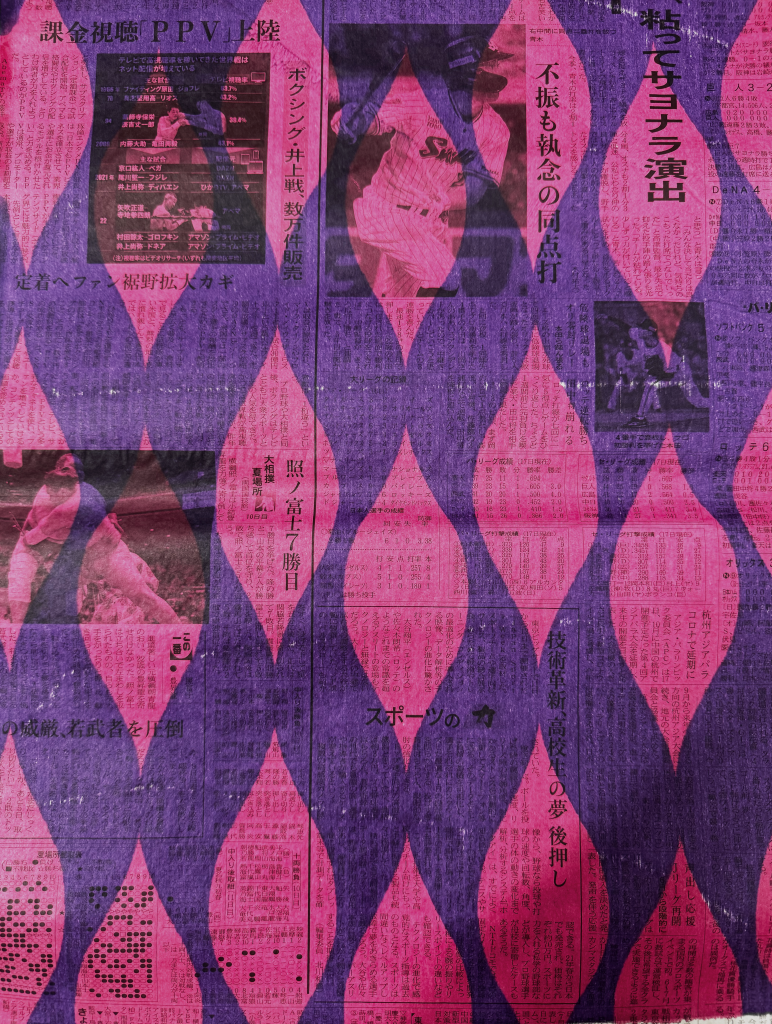
Stencil-printing synthetic dyes (nassen) onto warp threads before weaving enabled highly complex, multi-colored patterns. By the 1930s, this process evolved into a sophisticated double ikat style (heiyō-gasuri) achieved by stenciling both warps and wefts.
Meisen designs from this period drew heavily on Western modernist art movements, including Art Deco, Art Nouveau, and the Bauhaus. The resulting bold geometric shapes and vibrant, painterly motifs completely reinterpreted traditional kimono designs. Ultimately, these affordable, ready-to-wear Meisen kimonos, sold in modern department stores, became the signature fashion statement for independent, urban Japanese women (moga) during the Taishō and early Shōwa eras.
The process
1. Sourcing the Silk
- Unlike high-end kimonos made from pristine silk, Meisen traditionally utilized schappe silk or silk reeled from defective or deformed cocoons.
- Mechanized spinning technology allowed this lower-quality raw material to be spun into thick, glossy, and highly durable threads.
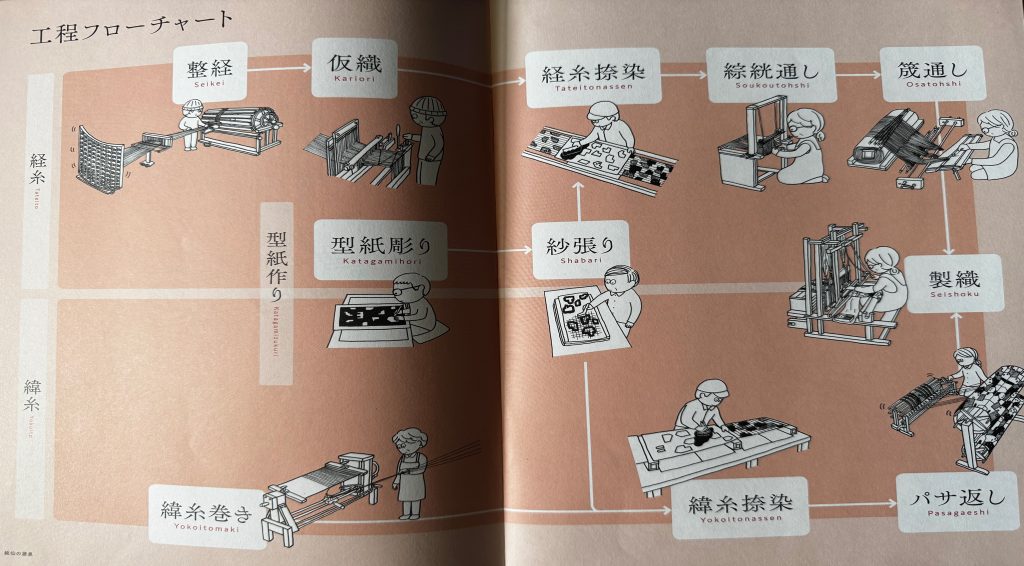
2. Pre-Weaving and Stabilization (Hogushiori)
- To prepare for dyeing, the warp (vertical) threads are laid out to their full length.
- They are temporarily woven with widely spaced, diagonal weft (horizontal) threads.
- This temporary weave holds the warp threads firmly in alignment so they can act as a stable “canvas” for the stencils.
3. Stencil Dyeing (Nassen)
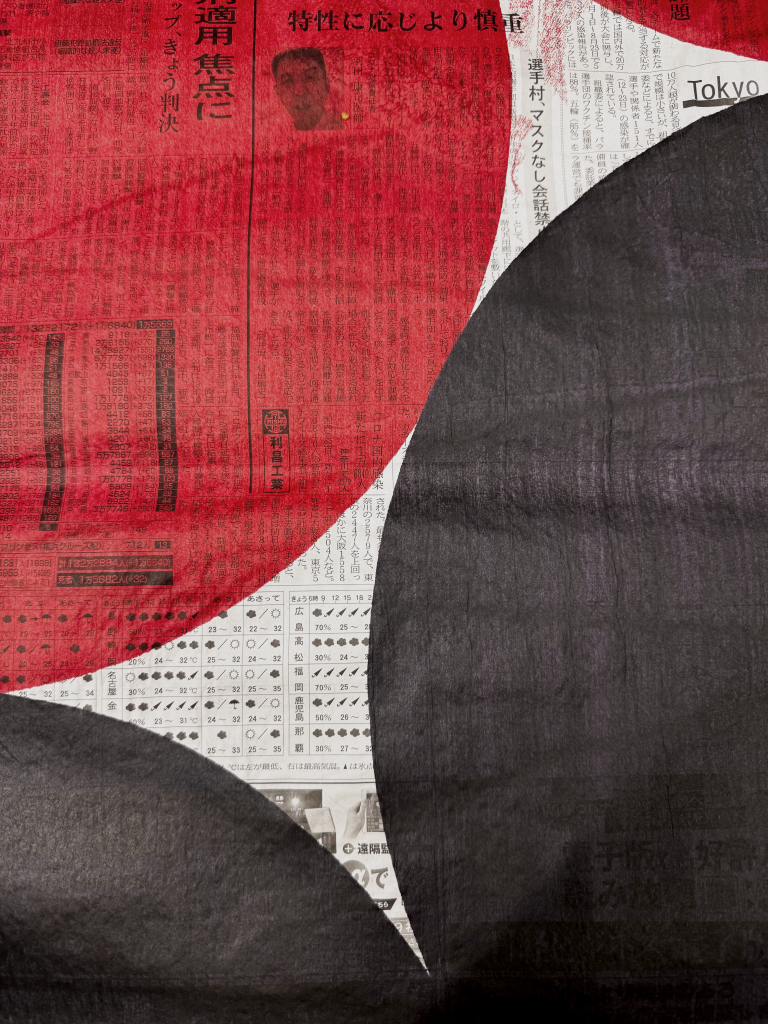
- Instead of hand-tying individual threads to resist dye—the laborious traditional kasuri method—artisans apply chemical aniline dyes directly to the stabilized threads using stencils.
- The synthetic dyes are mixed with a paste (often made from rice or the konnyaku plant) and pressed through the stencils using a spatula.
- A different stencil is used for each color in the design. This allows for the rapid creation of multi-colored, highly pictorial motifs that would be nearly impossible to achieve with traditional tie-dyeing.
4. Unraveling and Final Weaving
- Once the dyes are set (usually by steaming), the temporary weft threads are carefully unraveled and discarded.
- The dyed warp threads are then transferred to a hand or power loom.
- They are finally woven together with the true weft threads.
Because the threads inevitably shift ever so slightly during the final weaving process, the edges of the stencil-dyed patterns become subtly misaligned. This creates the distinctive, soft-focus “blurred” aesthetic that defines a Meisen kimono.